
Test scope, screenshots, checkpoint findings and tier rationale were supplied by an identified reviewer. Identity is retained internally unless public attribution is explicitly enabled.

Business innovation · South AfricaFull evidence record
OMISP
OMISP is presented as an innovation-management concept combining idea generation, execution frameworks and an AI assistant in a web prototype.
Sandbox Africa checked the submitted evidence and promoted the verified checkpoint record. Any visible adjustment is identified rather than silently rewritten.
The official public tier and technical record below are the verified publication outcome.
Tier 0 — Concept / Vaporware
Keep Tier 0. Genuine components exist, but the deployed product is not usable through normal entry paths and does not demonstrate a dependable core loop.
Strongest supporting evidence
Across all seven checkpoints, the platform fails or only partially passes on every measure except basic transport security. 22 of 24 tested navigation elements, calls-to-action, and footer links — including the primary navigation bar, both main calls-to-action, and every item in a four-column footer — are non-functional. A status indicator falsely reports "All systems operational" despite this. The homepage displays unsubstantiated trust claims (association with Google, Microsoft, Tesla, Y Combinator, and Techstars) and specific usage statistics (10,000+ ideas generated, 500+ startups accelerated, 98% success rate) that no functioning feature on the platform could have produced. No API or developer documentation exists. No legal or compliance documents are reachable, despite being labelled and linked. Homepage load time was slow at 8.48 seconds. Two components — the "Chat with OMI" AI assistant and a subset of interactive tool cards reachable only through one specific in-page path — were confirmed genuinely functional, but this does not constitute a usable core loop, since no standard entry point (navigation, footer, or primary CTA) leads to them.
Why the next tier is not yet supported
Tier 1 requires the core loop to work, even if unpolished. It does not, when tested the way any real user would encounter the product: through the navigation bar, the footer, or the primary "Start Innovating" call-to-action, every one of which leads nowhere. That two features function through an undocumented, narrow path demonstrates the underlying build has real components, not that the product is usable as deployed. Combined with fabricated trust signals and a false status indicator, the evidence supports a landing page presenting a partially built, largely non-functional product — the definition of Tier 0, not a judgement that no engineering exists behind it.
Verified findings and limitations
Direct review observations
The intern systematically tested navigation, calls-to-action, tool cards, footer links and the Chat with OMI assistant. Two narrow components worked, but 22 of 24 tested navigation/CTA/footer elements produced no useful response.
Independent verification
The current deployment remains on an auto-generated created.app builder subdomain, consistent with a prototype-stage public surface.
Observed issues
Most navigation and legal links are non-functional; the site reports all systems operational despite broad failures; trust logos and usage statistics were not independently substantiated.
Testing limitations
No company identity, production customer environment, integration documentation or usable end-to-end workflow was available.
Independent verification sources. Source 1
What was actually assessed
Loaded the platform at omisp-the-complete-framewo-523.created.app and reviewed the homepage content, noting the auto-generated builder subdomain and "Made with Anything" attribution. Systematically tested all navigation and interactive elements: the primary navigation bar (six items), both hero and closing calls-to-action, all interactive tool cards on the Features section, and all footer links across four columns (16 links, including four legal documents), recording which produced a response and which did not. Tested "Chat with OMI," the platform's AI assistant, with a business-related query to assess whether genuine AI functionality exists. Reviewed the homepage's trust and credibility claims — named company logos and quantified usage statistics — against the platform's demonstrated functional state. Checked the site's TLS/HTTPS status and measured homepage load time via browser DevTools. Searched for API or developer documentation; none was found. Attempted to locate company identity, founder information, or origin, which was not possible, as the About page — one of the non-functional links — was the only apparent path to this information.
Environment / device / browser
Edge on Windows
Account or access type
Business account
Access limitations
no About page functions,
What was observed
These images formed part of the evidence pack considered during verification. Full-standard records retain the contributor's factual caption for each screenshot.
Seven checkpoint assessment
The verified result is the official public checkpoint record. For earlier-standard reviews, these findings may have been reconstructed from preserved evidence during Sandbox Africa’s 2026 audit; they are not presented as if the contributor originally completed a structured worksheet. Contributor-submitted checkpoint wording is shown only where explicit public reviewer attribution has been enabled.
Step 1 — The Existence & Accessibility Check
Is it live?
Checking for dead links, infinite loading screens, or "Coming Soon" landing pages masquerading as live products.
Sandbox verifiedpartial
Site loads and renders fully. Only two of the primary navigation destinations function — Home and Features. All other primary navigation items (Challenges, Ideas, Execution, Tokens, Mini-Game, About), both hero and closing calls-to-action ("Start Innovating," "Start Your Innovation Journey," "Watch Demo"), and every footer link across four columns (OMISP World, Tools & Features, Support, Legal — 16 links total) produce no response when clicked.
Onboarding friction
Can a user or enterprise actually sign up, or is it gated behind broken "Contact Sales" forms?
Sandbox verifiednot assessed
No registration, sign-in or account system was found or referenced anywhere on the site. The platform appears to be used anonymously, if at all — this checkpoint may not apply to this product's model.
Step 2 — Functional Testing (The "Try It Out" Phase)
Core loop execution
Does the application actually do what it claims to do? (e.g. a payment gateway completing a test transaction, a logistics app's routing engine working.)
Sandbox verifiedpartial
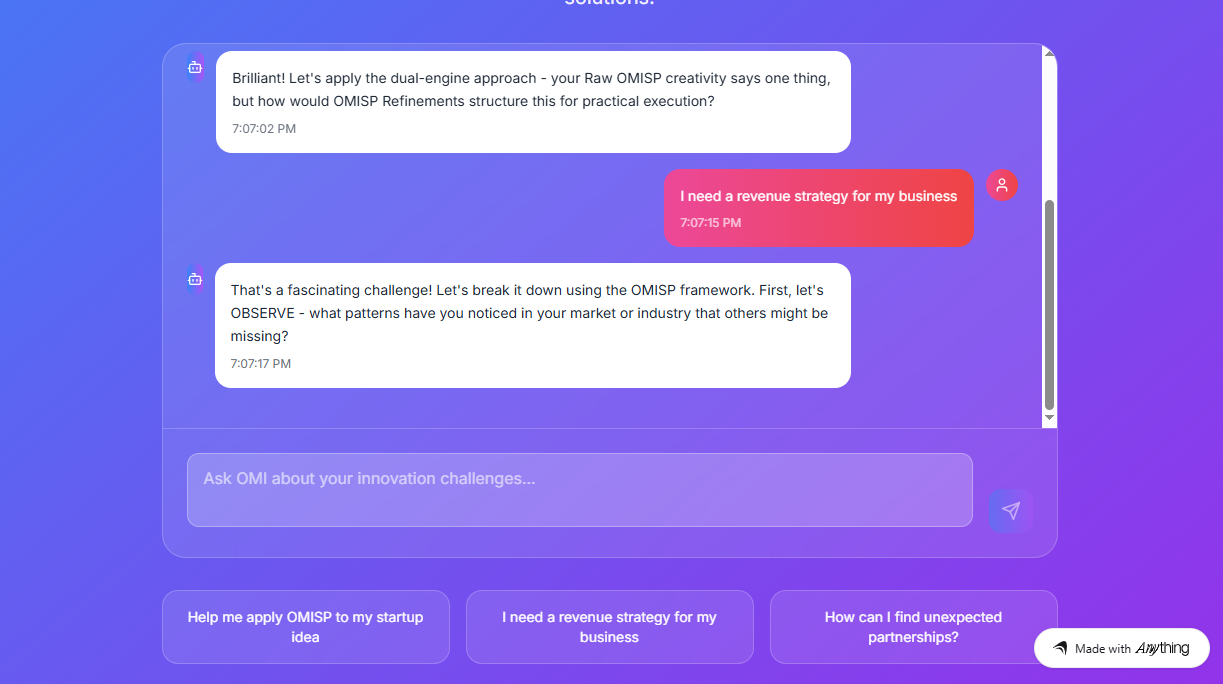
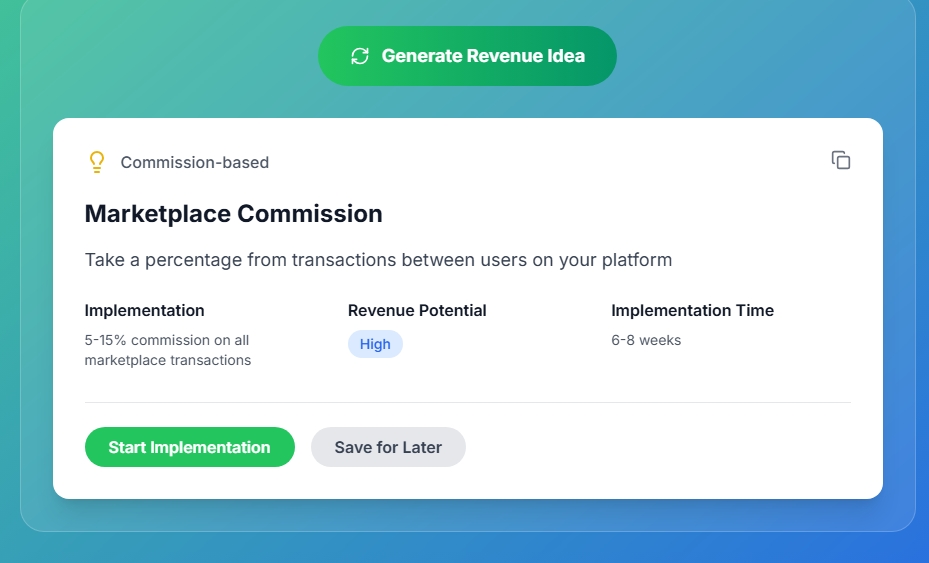
The core loop cannot be reached through standard navigation — the primary CTAs and nav bar are non-functional. However, direct testing confirmed two genuinely working features accessible only through specific in-page elements: interactive tool cards on the homepage Features section (OMI the Innovator, Revenue Generator, Solve the Problem, and others) open correctly when clicked directly, and "Chat with OMI," an AI assistant, responded coherently and contextually, correctly referencing the platform's own OMISP terminology and asking relevant follow-up questions. This confirms genuine underlying functionality exists, reachable only through a narrow set of correctly wired entry points.
User experience (UX) & interface (UI)
Assessing the logical flow, responsiveness, and basic accessibility of the platform.
Sandbox verifiedfail
22 of 24 tested navigation elements, calls-to-action, and footer links are non-functional. The platform displays a status indicator stating "All systems operational" despite this. The homepage additionally displays unsubstantiated trust claims — "Trusted by innovators at Google, Microsoft, Tesla, Y Combinator, Techstars" — and specific usage statistics (10,000+ ideas generated, 500+ startups accelerated, 98% success rate) that cannot be substantiated by any functioning feature on the platform, given the broken state of the tools that would generate this activity.
Step 3 — Technical & Architectural Assessment
Performance
Load speeds, uptime reliability, and basic stress responses.
Sandbox verifiedpartial
Homepage load time measured at 8.48 seconds via browser DevTools. This is a slow load for a marketing/landing page
Integration readiness
Availability, clarity, and functionality of API documentation and webhooks.
Sandbox verifiedfail
No API reference, developer documentation, or integration capability was located anywhere on the site.
Security basics
SSL certification, basic encryption standards, and data handling transparency.
Sandbox verifiedpartial
HTTPS confirmed secure. No privacy policy, terms and conditions, cookie policy, or disclaimer could be reviewed, as all four legal document links (present in the footer under "Legal") are non-functional — consistent with the broader footer link failure documented under Checkpoint 4. This means the platform displays the labels for standard legal documentation without any of it being reachable, which is a materially different and more concerning finding than simply lacking these documents: the platform presents an appearance of compliance infrastructure that does not function.
Company right of reply
Claim company profile
Represent OMISP?
Claiming verifies company ownership and enables a response or additional evidence. It does not permit editing of the independent review.